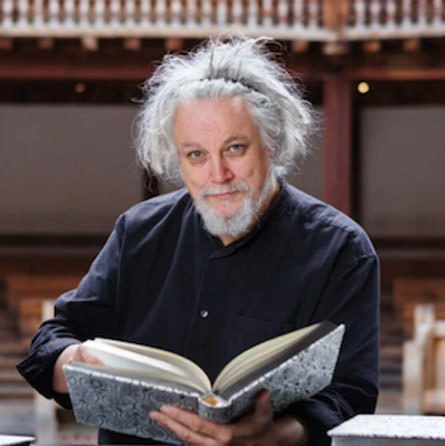
 Neil Packer: the artist behind the new BookBrunch logo
It's the work of award-winning artist, illustrator and author Neil Packer. He has turned his unerring artistic eye to illustrating many of the greats: Shakespeare, Harry Potter, The Divine Comedy, The Odyssey and The Iliad. And now BookBrunch.
"I haven't designed a logo in quite a while, so I was excited and anxious in equal measure," he says. The anxiety proved unfounded. "I think it is a rare example of one of those designs that was right first time, and it came both as an idea and an image very quickly, these are often the images that work best. It is clearly very simple and hopefully memorable, both essential traits for a logo.
"It is an abstracted image of two books seen from above, open midway and with their spines back-to-back roughly forming the letters BB. I don't know exactly how obvious that is, but I do know that if I had made it any more obvious it would begin to look crass and lose any flair that it might have. Design is all about a balance between information and style. That is not to say everything should be stylish – however, in the case of BookBrunch I think we can say that stylish is important."
Packer was one of those children who poured over picture books during his early years: "That distant memory is something I always have in mind when I am designing or writing books for children, and I always ask this question of my work: is this a book that would have excited or interested me as a child?" He still cites Alice and Martin Provensen, Richard Scarry, Virginia Lee Burton and "the great artists who illustrated the Ladybird books" as huge influences.
He studied graphics, illustration and print-making at Colchester, but it took "probably 10 years" to find the style that felt like his own. "It didn't help that I came to illustration via graphic design and it wasn't until I began thinking of illustration in a similar way as a device for presenting information that I began to find a style." The turning point was illustrating The Folio Society's edition of The Name of the Rose – where Packer's artful fusion of images and typography sprung into life.
Today, he finds inspiration in the most unexpected places (for example: the East Asian woodblock tradition), ideas swirling through his mind born of experience, and is sufficiently confident in his style to "push it" when required: "A good illustrator should understand what is needed and react to the brief accordingly."
Like the brief to design a new logo for BookBrunch which Packer – not a man who likes to stay in the same place for too long – designed whilst high in the sky: "Somewhere over the Ural Mountains. Their contours are probably etched for all time into the rough edges of the design and that's why it isn't perfect, but imperfection is so often far more interesting.
"This is what I love about design, that even a random gesture can have meaning and mystery and still convey an idea. A book in its physical form is a perfect design and a symmetrical object, but the narrative arcs which they contain are certainly not, they take us on roughly hewn journeys twisting and turning, uncertain of where they will end. This was what I was trying to convey, which is why when I got back home and sat down to work up the design I realised that it didn't need tidying up at all and that it was actually finished already."
Neil Packer's wisdom for would-be designers:
1. Be prepared to take some knocks along the way. I still get work rejected or returned for revision – and often justifiably so. Take it as a potential opportunity to improve something and remember that a creative mind sometimes works at its best when in a tight corner and up against a deadline. A pure and simple image that comes quickly can speak volumes more than an overly laboured idea.
2. Natural ability isn't everything, but if you really love what you do and have the desire and discipline to stick with it and are open to the idea of always trying to learn and improve, then with a little luck along the way it can be a rewarding lifelong experience. But it is probably not going to be easy, and you must be willing to make some sacrifices as is often the case with professions in the arts.
3. Be curious, find other obsessions from which to seek inspiration. Fine tune your eyes, ears and mind to the things you find beautiful and interesting – it doesn't necessarily even need to be visual – and draw inspiration from them.
Inset image: The new logo is a jaunty number with impact and character: unique, creative, forward-looking.
Image: Neil Packer/The Folio Society